Thailand stands at a crossroads. Once powered by a young and growing population, the country now faces fewer births, a rising elderly population, and a rapidly shrinking workforce. This is not a distant problem but one already reshaping the economy, society, and future of the nation. The question is not when the demographic crisis will occur, but whether Thailand can adapt quickly enough to survive.
Business leaders in Thailand are navigating a climate of uncertainty. Many trust the strength of their own companies, but confidence in the national economy has weakened. Political disruption, tariffs, and regional tensions have left the outlook fragile and the future unclear.
Thailand is facing a rising threat to its future workforce. Brain drain, the movement of skilled people abroad for better pay, opportunities and quality of life is easier than ever in a globalised world, and its effects on Thailand are already visible. As younger generations enter the job market, society and workplaces must recognise their changing needs and respond appropriately, as coupled with the country’s demographic pressures, the need to keep and grow a strong workforce has never been greater. The question is clear, will Thailand make the changes needed to reverse brain drain, or will it keep watching its skills slip away.
Building a Sustainable Business – 360 Degrees explores six key pillars for sustainable growth, combining strategic insights, best practices, and real-world examples to help businesses build resilience and thrive in an uncertain economy.
A great idea is worthless without the funds to bring it to fruition. One of the most underappreciated responsibilities of business leaders is to ensure adequate liquidity for each new endeavour that their companies embark upon. This task requires great insight into company operations and market patterns, as well as an excellent sense of timing, as the necessary cash must be available at the precise moment the organisation needs to access it. Whether a business is a well-established company or a fast-growing start-up, this principle holds true. Even the most seasoned organisations can falter if liquidity management is neglected, just as newer companies can fail to get off the ground without the right financial planning.
Left unchecked, all things fall into disorder. This universal law requires that we maintain high standards of maintenance and organisation in all aspects of both life and business. As soon as we allow ourselves slack in any area, the deterioration process will begin anew.
Privately held companies have more freedom to innovate than public companies as they are not beholden to shareholders who demand constant growth.
Thailand’s economy has demonstrated positive growth in the first half of 2024, yet the country continues to lag behind its ASEAN neighbours. As mid-market leaders weigh the impacts of global uncertainty, concerns over long-term investments in skills and technology are being raised, according to the latest findings from Grant Thornton's International Business Report (IBR) for Q3 2024.
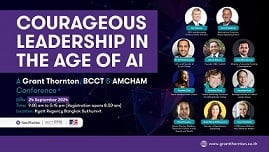
Leading in an AI-powered world requires bold decision-making and strategic foresight.
The Grant Thornton International Business Report (IBR) for H2 2023, which measures sentiment amongst mid-market business leaders, shows a considerable drop in overall business health across Thailand.
For mid-market businesses, navigating the environmental, social and governance (ESG) landscape is a complex challenge, and their approach will depend on size, maturity, sector – and the priorities of stakeholders.
Diversity, equity, and inclusion (DEI) are more than just policies and marketing tools. They are quickly becoming a top priority for organisations of all types and sizes, as companies that embrace DEI outpace their competitors and perform better as a result of integrating DEI principles as part of their core DNA.
Thailand would still be unable to return to its pre-COVID economic trajectory. The problem boils down to simple demographics. Thailand, like a number of other countries, is currently undergoing a pair of developments whose implications are hugely underappreciated.
The Ministry of Commerce recently withdrew its endorsement of Thailand joining the CPTPP over concerns that the trade deal may harm farmers.
Organisations that are experiencing a slowdown in business activity due to the COVID-19 crisis should take this opportunity to upskill their workforces.