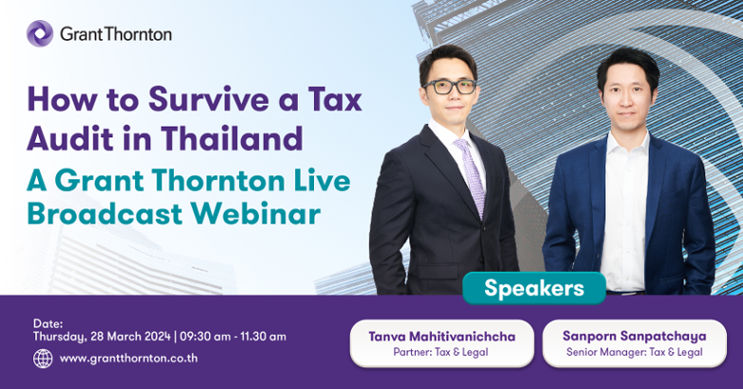
As we reflect on the challenges and opportunities of the past year, it's evident that many Thai entities have faced heightened scrutiny through tax audits, particularly amidst requests for tax refunds or company dissolutions. As we embark on 2024, we're gearing up with renewed determination to tackle this challenge head-on. We're excited to announce our initiative to raise awareness surrounding tax audits in these specific scenarios.
Grant Thornton Thailand cordially invites you to a highly interactive workshop on hyperautomation.
As technologies such as Robotic Process Automation, Artificial Intelligence, and Blockchain become increasingly integrated in the auditing industry, auditors will need to adjust their focus in order to thrive in this rapidly changing environment.
The International Accounting Standards Board (IASB) regularly publishes new International Financial Reporting Standards (IFRS), Interpretations of Standards (IFRIC) or amendments to existing IFRS Standards. In response to these, the global IFRS team publishes IFRS Alerts on these changes (and other issues relevant to IFRS) as they are announced so that you can keep up to date.
For any industry reshaped by rapid technological growth, new business models must be accompanied by the development of complementary skillsets among its employees. The world of auditing is no different; as ever more advanced service capabilities raise client expectations, there is an increasing recognition among accountants that – as the saying goes – “what got you here won’t get you there”. Indeed, auditors in the financial services industry have traditionally prioritised skills such as accounting, risk management, IT and data analytics when looking to land their desired job. Training in these areas will remain essential for some time to come; however, an oft-overlooked set of “soft skills” is becoming ever more relevant in today’s age of digital transformation. These abilities emphasise the human side of business interaction, where interpersonal communication leads to understanding in a way that technology alone cannot yet replicate. With technology now playing a massive role in the finance industry along with other business sectors, auditors now have greater technical abilities at their fingertips than ever before. In such an environment, where computers can outperform even the best and most experienced auditors at fundamental tasks, the traditional role of the auditor can now expand into new areas. It is therefore worth exploring the challenges and opportunities of this new ecosystem, with an eye toward the particular skills that auditors can develop in order to differentiate themselves from their fellow auditors – as well as their silicon-based assistants.
Advances in data analytics are allowing today’s auditors to gain greater insights into their clients’ organisational structure and provide them with higher levels of assurance at similar or even lower costs than ever before.
As one of the world’s purest examples of information collection, organisation, and processing, auditing is set up to benefit from the latest advances in software in a way that few other sectors can match. Data analytics, artificial intelligence, machine learning, robotic process automation – these and other related innovations are a perfect fit for the complex demands of the auditing world. Many of the challenges facing the current generation of auditors involve the close reading of contracts, identification and analysis of transactions, reconciliation of accounts, checks for anomalies and inconsistencies, and generation of reports. With the benefit of new technology, each of these requirements can now be met faster and at a higher level of accuracy than ever before.
A single Standard (TFRS 15) replaces IAS 18, IAS 11 and the numerous revenue-related Interpretations. It provides a single, principles-based framework that should improve comparability of revenue recognition across entities and industries, also filling in many of the existing gaps in the current TFRS revenue guidance (like multiple element arrangements and guidance on warranties). Finally, the new Standard will close the current disclosure gap.
Each year the requirements of International Financial Reporting Standards (IFRS) change. New Standards and Amendments become effective and these determine the presentation of primary financial statements and accompanying disclosures. As a result companies face the challenge of updating their financial statements every year.
IFRS News is your quarterly update on all things relating to International Financial Reporting Standards.
The Federation of Accounting Professions announced a new standard on accounting for financial instruments which application will be effective date on 1 January 2020. The new TFRS 9 is based on IFRS 9 issued by The International Accounting Standard Board which fundamentally rewrites the accounting rules for financial instruments.
The Chinese authorities have released proposed changes to tax law that may significantly impact how international assignees and long-term expats in the People’s Republic of China (PRC) are taxed. From changes to residency, personal taxation, payroll withholding and tax efficient benefits for assignees, the potential changes are far reaching.
IFRS News is your quarterly update on all things relating to International Financial Reporting Standards.
Currently, IFRS does not provide specific guidance on accounting for crypto assets. This IFRS Viewpoint seeks to explore the accounting issues that arise for miners and validators in mining and maintaining the blockchain in accordance with existing IFRS.
IFRS News is your quarterly update on all things relating to International Financial Reporting Standards.
The new leasing standard - IFRS 16 'Leases' has been issued by the IASB. The core principle of the new standard is that lessees should recognise all leases on their balance sheet.