Across boardrooms and executive meetings this year, I’ve noticed something striking: executives are talking a lot about roles - but not enough about capability. The focus is almost always on vacancies - what's open, what’s urgent, and who can fill it. But in a market shaped by demographic shifts, emerging tech, and increasingly fluid career paths, the real risk isn’t an open role. It’s a critical capability gap - one you may not realise you have until it's too late.
At the start of every year, the same urgency kicks in: "We need someone now." A resignation lands, a new project begins, a headcount is approved - and suddenly, we're back on the treadmill of reactive hiring. But what if 2026 is the year we stop doing that? Not long ago, I was speaking with the COO of a regional industrial group in Thailand. His team had just made two senior hires where both came with strong profiles, ticked the usual boxes and six months in, were underwhelming.
As the year closes, leadership teams across Thailand are finalising their 2026 strategies - refining targets, outlining transformation plans, and setting bold growth ambitions. But amid all this planning, one critical question often gets overlooked: Are the people who will carry this strategy into 2026 the right ones to do it? In my recent conversations with CEOs and CHROs, the answers to this question are rarely clear. Many leaders think they’ve got the right team - but they haven’t pressure-tested that belief. The world is changing fast, and the leadership qualities required even two years ago may not match what’s needed next year.
In recent months, I’ve written about what it takes to create real momentum within organisations: how leadership, structure, process, and culture each play a role in determining whether the strategy translates into performance. But as we enter the final quarter of the year, I find myself reflecting on something even more fundamental.
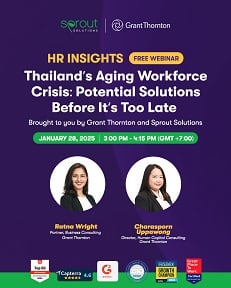
Thailand is facing a rising threat to its future workforce. Brain drain, the movement of skilled people abroad for better pay, opportunities and quality of life is easier than ever in a globalised world, and its effects on Thailand are already visible. As younger generations enter the job market, society and workplaces must recognise their changing needs and respond appropriately, as coupled with the country’s demographic pressures, the need to keep and grow a strong workforce has never been greater. The question is clear, will Thailand make the changes needed to reverse brain drain, or will it keep watching its skills slip away.
Thailand’s plummeting workforce is a multi-dimensional and critical crisis demanding immediate action from businesses.
Hiring decisions for senior level positions can save — or ruin — businesses in any industry. The right person for the job will have a clear vision of the opportunities and challenges ahead, the maturity to make wise decisions, the drive to dig deeper when the going gets tough, and the leadership qualities that will bring together a hard-working team to push forward.
Leading in an AI-powered world requires bold decision-making and strategic foresight.
Globally, women hold 32.0% of senior management positions in the tech sector, below the global average of 33.5%, and below other industries such as professional services (36.2%), asset management (35.5%), and healthcare (37.7%).
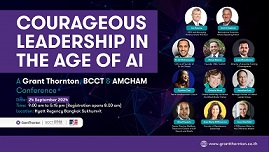
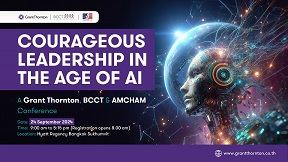
Bangkok, Thailand – On September 24, 2024, Grant Thornton, in collaboration with the British Chamber of Commerce Thailand (BCCT) and the American Chamber of Commerce in Thailand (AMCHAM), will host a groundbreaking conference titled “Courageous Leadership in the Age of AI” at the Hyatt Regency Bangkok Sukhumvit. This full-day event is set to bring together over 300 senior executives, business owners, and emerging leaders to explore the critical intersection of leadership and artificial intelligence (AI) in today's rapidly evolving landscape.
Grant Thornton, BCCT & AMCHAM are thrilled to invite you to our upcoming full-day conference, "Courageous Leadership in the Age of AI," on Tuesday, 24th September 2024 at the Hyatt Regency Bangkok Sukhumvit.
The Grant Thornton International Business Report (IBR) for Q2 2024 reveals a nuanced outlook among Thailand's mid-market business leaders. With a Business Health Index score of 16.3, Thailand continues to outperform its ASEAN, Asia-Pacific, and global peers. However, underlying economic concerns tell a different story and highlight the need for strategic vigilance.
We’ve all seen it: Companies coasting on past successes, telling themselves that they’ll start to push ahead in earnest once the economy gets better, and treading water in the meantime by focusing on modest incremental improvements in the products and services of which they used to be pioneers. They will have their reasons, and most will sound perfectly sensible when expressed and explained. But businesses should be extremely wary of all attempts to rationalise inaction, or deliver excuses rather than results. If an organisation’s key obstacles are not being aggressively addressed, the deeper problem is usually a lack of internal direction or urgency. Both of these are failures of leadership.
Diversity, equity, and inclusion (DEI) are more than just policies and marketing tools. They are quickly becoming a top priority for organisations of all types and sizes, as companies that embrace DEI outpace their competitors and perform better as a result of integrating DEI principles as part of their core DNA.
As we enter the third year of this pandemic, many businesses have made the shift to a hybrid work model. The following tips can help your organisation embrace a successful and sustainable hybrid work model, to prosper throughout the remainder of this pandemic and beyond.