Effective 1 August 2026, Central Registration Office Order No. 2/2569 Regarding Criteria and Supporting Documents for Registration of Partnerships and Limited Companies Involving Foreign Shareholders or Foreign Authorised Signatories (the “Order”) repeals previous Orders Nos. 2/2568 and 1/2569. The Order was introduced to strengthen the integrity and credibility of company registrations, enhance transparency regarding the source of investment funds, and prevent nominee arrangements used to circumvent restrictions under the Foreign Business Act. It also supports the Government’s efforts to address concealed ownership structures and suspicious financial transactions.
Details of the additional documentation requirements are summarised below.
A. Registration of New Partnerships or Companies (Clause 2 and Clause 3)
Where a partnership or limited company is established in either of the following circumstances:
- foreign partners/shareholders holding less than 50% of the registered capital; or
- no foreign shareholders but a foreign national is an authorised signatory/director (in case of a company),
The applicant must submit the following documents to the Department of Business Development (DBD):
(i) Investment Explanation Letter (in the DBD’s format);
(ii) Bank statements (issued by the bank) covering 3 months before the capital payment from each Thai shareholder's account showing the withdrawal or transfer of the investment funds corresponding to the amount invested and the date of payment; and
(iii) Bank statement of the account receiving the share capital, whether the company’s account or the managing partner/director’s account used to receive the subscription monies, showing receipt of funds from every shareholder consistent with the subscribed capital.
If the managing partner’s or director’s personal account is used to receive the capital contribution, you must also submit a three-month bank statement for that account.
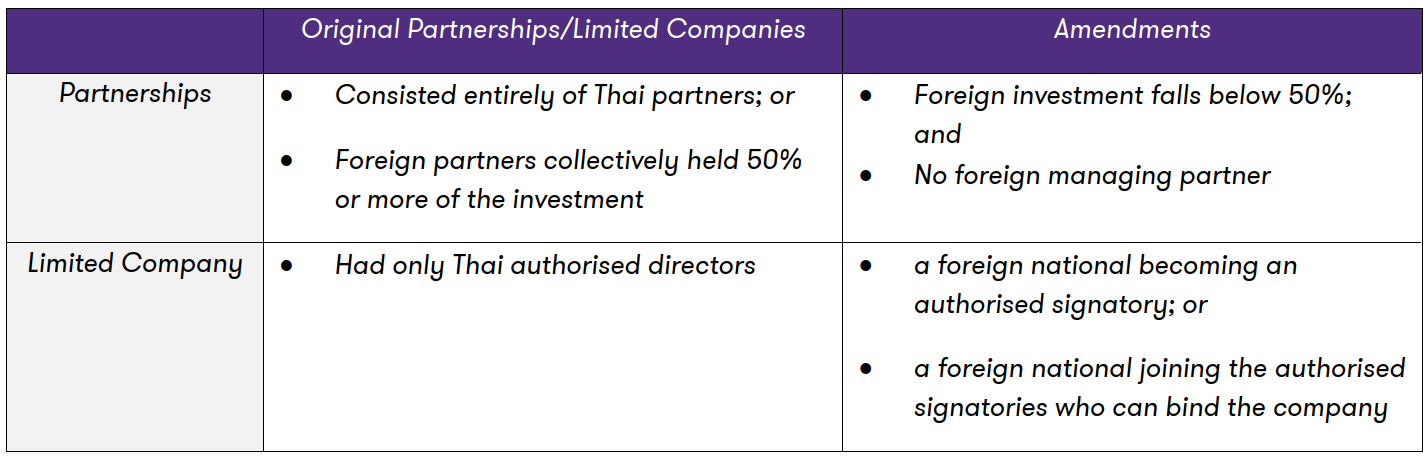
Registration of Amendments (Clause 4)
An Investment Confirmation Letter (in the DBD’s format) must accompany applications to amend the registration in any of the following circumstances.
![]()
B. Registration of Amendments within 1 Year (Clause 5)
This Order also introduces a new requirement for companies or partnerships incorporated after the Order becomes effective on or after 1 August 2026. Where an amendment under Clause 4 is filed within one year from incorporation, applicants must also provide evidence that the subscribed capital has actually been paid.
You must also submit the following documents to the DBD:
(i) Investment Explanation Letter (in the DBD’s format); and
(ii) Bank statement showing receipt of the investment funds into:
- The partnership/company account; or
- The managing partner/director's account used to receive the capital,
demonstrating receipt of the full subscription amount corresponding to the original incorporation.
For example, if a company were incorporated on 5 August 2026 with only Thai authorised directors and subsequently files an application on 5 December 2026 to amend its authorised signatory structure by appointing a foreign authorised director to jointly sign with a Thai authorised director, the company would be required to submit the following documents to the DBD together with the amendment application: (i) an Investment Confirmation Letter confirming that the shareholders have made genuine capital contributions and that the company is not operating through nominee arrangements; (ii) an Investment Explanation Letter setting out details of the receipt of share subscription payments; and (iii) a bank statement of the company’s account or the director’s account used to receive the share subscription payments.
Overall, Order No. 2/2569 represents an administrative consolidation with targeted enhancements, rather than a complete overhaul. The most material new obligation is the requirement to produce evidence of actual capital receipt for qualifying amendments made within one year after incorporation, reflecting the DBD’s increased focus on verifying genuine investment and preventing nominee arrangements.