
Continued Uncertainty, Diverging Optimism: Thailand’s Mid-Market Resets for 2026
Continued volatility is shaping the global economic landscape as we enter 2026 and optimism is diverging. Globally, mid-market confidence remains relatively resilient, with 74 percent of leaders expressing optimism about prospects over the next 12 months, despite a modest moderation. In Thailand, however, sentiment has softened more markedly. Only 19 percent of respondents report they are very confident in economic improvement, down from 31 percent in the previous quarter, while levels of uncertainty have risen. This widening confidence gap reflects the impact of trade tensions, domestic political pressures and persistent structural constraints. As regional growth dynamics shift, Thailand’s mid-market is entering a period of strategic reset, recalibrating investment priorities, productivity drivers, and innovation to sustain competitiveness in a more demanding operating environment.
Outlook for 2026
Thailand’s economy is navigating sustained external and domestic pressures. Despite government efforts to stimulate growth, political developments, global trade tensions, and structural constraints continue to weigh on business and investor sentiment. This is evidenced by Thailand’s mid-market not placing enough emphasis on technology adoption and productivity enhancement. Investment in people, capability development, and operational agility will be central to strengthening competitiveness and supporting long-term growth.
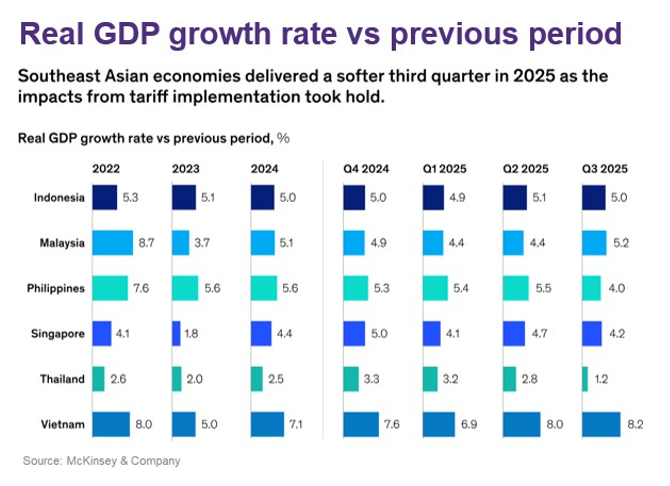
This divergence in optimism is mirrored in regional economic performance. Real GDP growth across Southeast Asia moderated in the third quarter of 2025 as tariff effects weighed on momentum. Vietnam led the region at 8.2 percent, while Malaysia and Indonesia remained stable at 5.2 percent, its weakest performance since 2021. The widening performance gap highlights intensifying competitive pressure within ASEAN and reinforces the urgency for Thailand’s mid-market to sharpen its strategic focus.
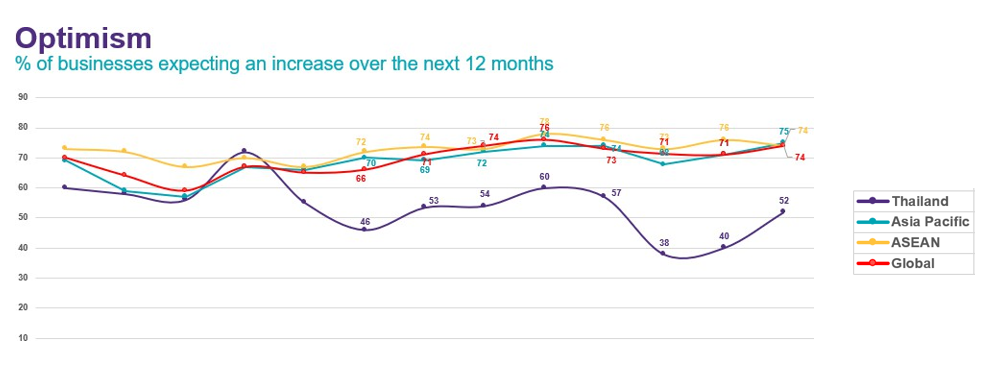
Beyond cyclical pressures, structural forces are also shaping business confidence. While optimism among Thailand’s mid-market has recovered from its mid-2025 low, it remains below regional and global benchmarks. Demographic realities, including a rapidly aging population and tightening labour supply, are influencing hiring expectations, capital allocation, and long-term growth planning. Confidence is therefore increasingly linked to the ability to enhance productivity, leverage technology, and adapt to workforce transformation.
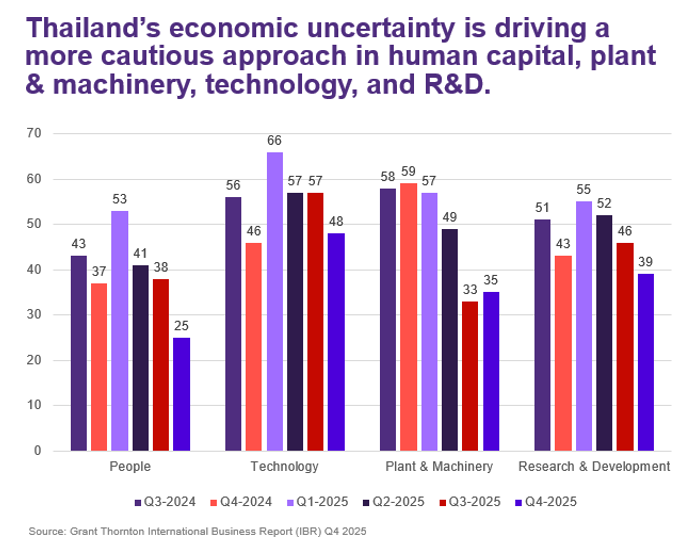
This more measured outlook is clearly reflected in investment intentions. Planned spending across human capital, technology, plant and machinery, and research and development has declined from earlier peaks, with particularly noticeable pullbacks in plant and machinery and R&D. While technology investment remains comparatively more resilient, overall capital allocation has moderated, signalling heightened cost discipline and a more cautious approach to expansion. The broad-based easing in investment underscores a shift toward risk management and operational efficiency, as Thailand’s mid-market prioritises stability and capital preservation while navigating economic and structural headwinds.
Ian Pascoe, CEO & Managing Partner, Grant Thornton Thailand, said:
“Thailand’s growth has slowed, exports and tourism remain exposed to external shocks, and high household and corporate debt continue to weigh on sentiment. Now is the time for action. Structural challenges such as low productivity and demographic change can no longer be ignored. Technology, particularly AI, is emerging not as an option, but as a necessity to sustain competitiveness. The businesses that succeed in 2026 will be those that invest deliberately in people, capability, and operational resilience responding decisively to uncertainty rather than waiting for clarity”
Looking ahead, Thailand’s mid-market needs to be increasingly focused on productivity enhancement, technology adoption, and operational agility. Rather than retrenchment, businesses should be recalibrating, balancing prudence with the need to sustain innovation and long-term growth.
Chris, Chairman, Grant Thornton Thailand, added:
“Periods of uncertainty test not only economic strength, but leadership discipline. The IBR Thailand findings point to a more cautious business environment shaped by global volatility and domestic constraints. Long-term competitiveness will depend on how effectively businesses address productivity, governance and talent development while embracing technological change responsibly. With the right strategic focus, Thailand’s mid-market can remain a durable engine of growth, even in a more complex global landscape.”


Download a copy of Grant Thornton IBR Q4 2025
-
![Rattanakorn]() Rattanakorn (KJ) Sutthiphongkait Marketing professional with 14+ years of experience in branding, digital marketing, and strategic communications. Currently Marketing Communications and Branding Manager at Grant Thornton Thailand, driving brand visibility and stakeholder engagement. Former Strategic Partnership Manager, leading value-driven collaborations and business growth.
Rattanakorn (KJ) Sutthiphongkait Marketing professional with 14+ years of experience in branding, digital marketing, and strategic communications. Currently Marketing Communications and Branding Manager at Grant Thornton Thailand, driving brand visibility and stakeholder engagement. Former Strategic Partnership Manager, leading value-driven collaborations and business growth.Let’s connect and explore opportunities to collaborate!