Three disciplines. One objective: protecting the organisation.
The nature of organisational risk is evolving. As businesses become increasingly digital, threats no longer fall neatly into separate categories of fraud, cyber incidents, or investigations. Instead, many modern incidents span all three disciplines, creating complex challenges that require an integrated response.
Today, a single event can begin with a compromised account, progress to unauthorised access to sensitive information, result in financial losses, and ultimately require a detailed forensic investigation. This convergence is reshaping how organisations think about risk management, resilience, and incident response.
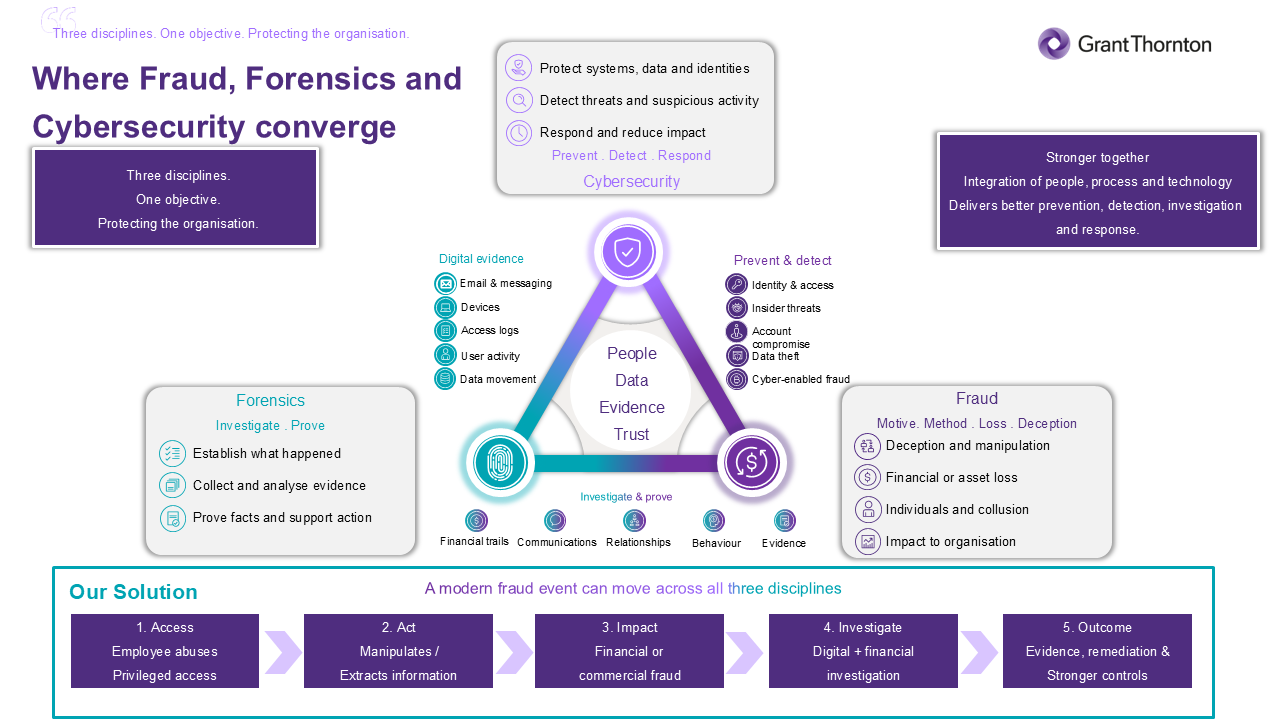
The Growing Intersection of Risk
Traditionally, cybersecurity, fraud management, and forensic investigations operated as distinct functions.
Cybersecurity focused on protecting systems, data, and digital identities. Fraud specialists concentrated on deception, financial loss, and misconduct. Forensic investigators stepped in after an incident to establish facts, collect evidence, and support remediation efforts.
However, the boundaries between these disciplines are becoming increasingly blurred.
A cyber attack may be motivated by financial gain. An insider fraud scheme may involve the theft of sensitive data. A business email compromise case may require digital evidence analysis alongside financial tracing to determine the full scope of the incident.
As a result, organisations need a holistic approach that combines prevention, detection, investigation, and response.
A Shared Focus: People, Data and Evidence
At the centre of every fraud, forensic, and cybersecurity engagement are three critical elements:
- People who interact with systems and information
- Data that enables business operations and decision-making
- Evidence that helps organisations understand what happened and why
By analysing digital evidence such as emails, messaging records, devices, access logs, user activity, and data movements alongside financial records, communications, and behavioural patterns, organisations can gain a more complete view of potential risks and incidents.
This integrated perspective enables organisations to identify threats earlier, investigate more effectively, and make informed decisions based on reliable evidence.
Understanding the Modern Fraud Lifecycle
Many fraud events today move across all three disciplines throughout their lifecycle.
1. Access: An individual gains access to systems, applications, or sensitive information, often through privileged permissions or compromised credentials.
2. Act: Information is manipulated, extracted, shared, or misused for personal gain or other malicious purposes.
3. Impact: The organisation experiences financial loss, operational disruption, regulatory exposure, or reputational damage.
4. Investigate: Digital and financial investigations are conducted to establish facts, analyse evidence, and determine the root cause of the incident.
5. Outcome: Organisations implement remediation measures, strengthen controls, enhance monitoring capabilities, and address identified vulnerabilities.
This journey demonstrates why effective risk management requires expertise that extends beyond individual disciplines.
Stronger Together
The most effective organisations recognise that fraud, forensics, and cybersecurity are not standalone capabilities. Instead, they form a connected framework that brings together people, processes, and technology to address increasingly sophisticated threats.
By integrating these disciplines, organisations can:
- Enhance threat prevention and detection capabilities
- Improve the speed and effectiveness of incident response
- Conduct more robust and defensible investigations
- Reduce financial and operational impacts
- Strengthen governance, risk management, and internal controls
In today's connected environment, protecting an organisation requires more than a cybersecurity strategy, a fraud programme, or an investigation capability in isolation. It requires a coordinated approach that recognises the overlap between all three disciplines and leverages their combined strengths.