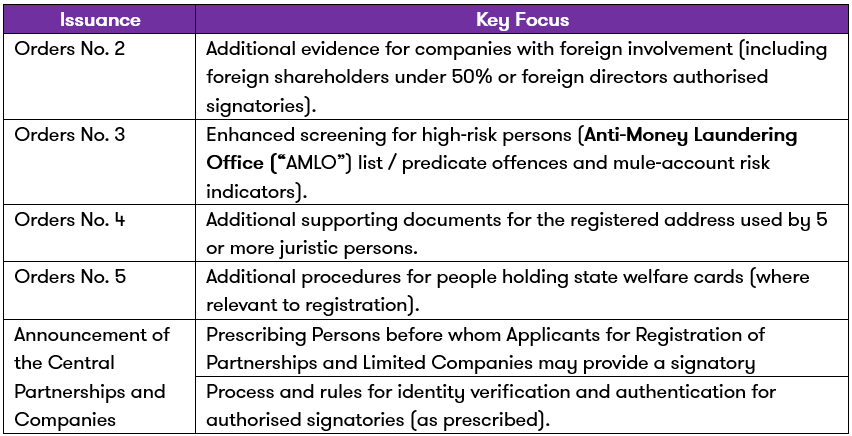
In late December 2025, the Department of Business Development (“DBD”) issued four Orders of the Central Partnerships and Companies Registration Office, together with an Announcement of the Central Partnerships and Companies Registration Office (collectively, the “Orders”), to strengthen corporate registration controls. The summary of the Orders is set out below.
What changes in compliance and implications
Here are the key considerations from the recent Orders and Announcements, which the DBD aims to prevent the use of nominees, promote corporate transparency, and ensure the registration integrity.
1) Verify funds contribution of Thai shareholders
Under Order No. 2/2568, during the incorporation stage, if a company either (i) has any foreign shareholder holding less than 50% of registered capital or (ii) no foreign shareholders but the authorized director is foreigner all Thai shareholders must submit bank statements covering at least 3 months prior to the capital or share payment from the account used to make the investment.
2) AMLO and DBD sharing list of individuals connected with the predicate offence
DBD’s review now includes screening of partners, directors, and shareholders against AMLO lists. At the registration of incorporation or amendment, if the DBD notices that any directors or shareholders are listed by AMLO, before the filing is accepted, the registrar may require such person:
(i) To appear in person with identification to verify identity.
(ii) To provide bank statements covering at least 3 months prior to the capital or share payment from the account used to make the investment.
(iii) To provide a letter of consent for the registered address, plus the original and a copy of the proof of ownership documents.
3) Additional requirement for registered office with more than 5 entities
Where the proposed head office address is already registered to 5 or more juristic persons, the registrar may request:
(i) A letter of consent from the person entitled to allow use of the premises, and
(ii) Supporting documents evidencing the right to use the address (for example, title deed), with originals for inspection.
GT’s suggestion
1) Review your company’s shareholding structure early. Thai shareholders should be able to explain their sources of funds and provide clear supporting documents at the time of registration, even if the foreign shareholding is only 1%.
2) Conduct internal checks to ensure that none of your shareholders or directors is listed by AMLO.
3) If you plan to use a shared office or co-working space, make sure the provider can supply sufficient documents to meet the DBD’s requirements.
Conclusion
Overall, these Orders and Announcements reflect the DBD’s shift toward a more substance-based registration review, with a focus on nominee risk, corporate transparency, and registration integrity. In practice, this does not mean that the government is rejecting legitimate foreign investment in Thailand with a clean source of funds. Rather, due to the increasing number of cases involving illegal activities using Thai nominee shareholders and limited companies as vehicles, the DBD has become more cautious at the registration stage.
How Grant Thornton Can Help You
At Grant Thornton in Thailand, our team of tax and legal experts are ready to advise on structuring cross-border technology arrangements to ensure alignment with Thai tax laws and international tax treaty obligations.
-
 Tanva Mahitivanichcha Tanva advises clients on customs and trade compliance matters including customs audits and dispute resolution, customs valuation, product classification, regulated and import/export controlled substances, trade privileges, board of investment promotion projects, customs free zones, excise tax, board of investment privileges, and product rules of origin verifications.
View Profile -
 Sanporn Sanpatchaya Sanporn joined Grant Thornton Thailand in 2013. Prior to that he was a legal consultant for four years. His experiences are within tax and legal scopes, and he has provided tax and legal advisory, as well as legal and tax procedure advice on various subjects.
View Profile