New US “overcapacity” tariffs: what the proposed Section 301 action means for Thai exporters

27 Nov 2026 2 min read
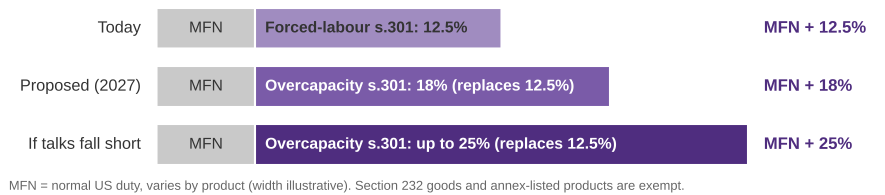
On 25 November 2026, days after Thailand and the US confirmed that talks on their reciprocal trade agreement were substantially complete, the US Trade Representative (USTR) proposed new tariffs on 14 economies, including Thailand. Washington says government policy in these economies keeps factories producing beyond market demand, which it calls “structural excess capacity”. The proposal will likely set the US tariff on most Thai goods for 2027.
How we got here
In February 2026 the US Supreme Court ruled that tariffs could not be imposed under emergency powers, ending the 19% “reciprocal” rate on Thai goods. A temporary 10% tariff followed, replaced on 24 July by a 12.5% tariff under Section 301 of the Trade Act of 1974 over forced-labour enforcement. Section 301 allows the US to act against foreign practices it considers unfair and has a long record of surviving court challenges. The new proposal is a second Section 301 case.

Five points businesses should note
1. A proposed rate of 18%, possibly 25%. The rate could rise to 25% if USTR finds Thailand’s commitments and ongoing consultations unsatisfactory.
2. It replaces the current tariff rather than adding to it. The new tariff would take the place of the 12.5% forced-labour tariff. Normal MFN duties still apply underneath.
3. Section 232 goods are carved out. Goods already under US national-security tariffs, such as steel, aluminium and copper articles, vehicles and parts, wood products, patented pharmaceuticals and semiconductors, would not face the new tariff.
4. A long list of product exemptions. Examples relevant to Thailand include natural rubber; fresh durians, mangoes and pineapples; cassava and tapioca; coffee and cocoa; computers and parts, including disk drives; smartphones; integrated circuits; crude oil and LNG; fertilisers; and gold. Some items, such as air conditioners and lithium-ion batteries, are exempt only as aircraft articles, and rice, seafood, poultry, rubber gloves and jewellery are not on the list.
5. It is not yet final. Comments are due by 5 January 2027 and hearings begin on 25 January. Final rates will most likely take effect in the first quarter of 2027.
What this means in practice
Businesses should check each product against the annex by its full US tariff (HTS) code and model landed costs at 12.5%, 18% and 25%, then agree with US buyers how the cost will be shared. Exporters of non-exempt products should consider filing comments, as USTR has asked which products should be added to or removed from the list.
Questions still to be answered
Will the final trade agreement, which still needs Thai Cabinet approval, keep Thailand at 18% rather than 25%? Thailand is also seeking a cut in the forced-labour rate to 10%, but as drafted that would matter only until the 18% takes effect. And which products will the exemption list gain or lose after comments?
Businesses that review their classifications, pricing and supply chains now, and take part in the comment process, will be best placed for 2027.
Authors
-
Tanva Mahitivanichcha
Tanva advises clients on customs and trade compliance matters including customs audits and dispute resolution, customs valuation, product classification, regulated and import/export controlled substances, trade privileges, board of investment promotion projects, customs free zones, excise tax, board of investment privileges, and product rules of origin verifications.View Profile